
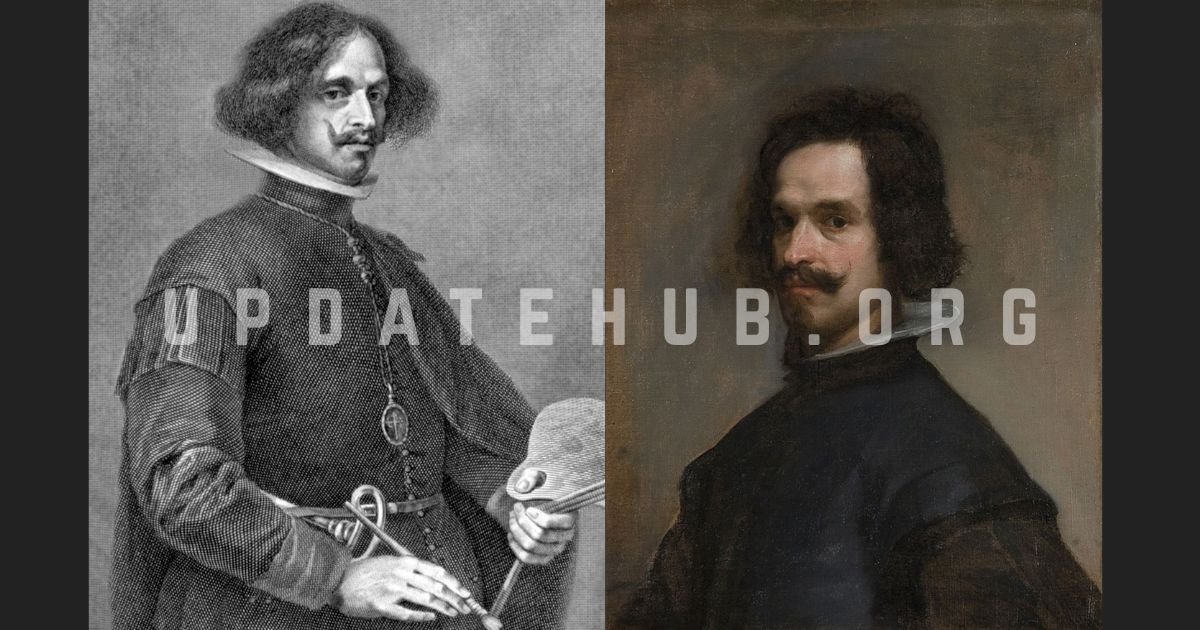
Diego Velázquez was one of the greatest painters of the Spanish Golden Age and one of the most influential artists in Western art. Best known for Las Meninas, he developed a remarkably natural approach to portraiture that combined technical skill with psychological depth.
Born in Seville in 1599, Velázquez began his career in a city known for its thriving artistic culture. His early paintings reveal an interest in ordinary people, natural light, textures, and everyday life. After moving to Madrid, his career changed dramatically when he became a painter to King Philip IV of Spain.
Working at the royal court gave him opportunities to paint monarchs, members of the royal family, nobles, servants, and important political figures. It also exposed him to major European artworks and helped him develop a sophisticated style based on subtle color, atmosphere, light, and loose but remarkably controlled brushwork.
His career was not limited to royal portraiture. He created historical scenes, religious subjects, mythological paintings, and some of the most memorable portraits of the 17th century. Centuries later, artists such as Édouard Manet, Pablo Picasso, and Francis Bacon continued to study and reinterpret his work.
This article explores his early life, career, artistic style, greatest masterpieces, royal connections, Italian journeys, and lasting influence.
Early Life and Artistic Education
Diego Rodríguez de Silva y Velázquez was born in Seville in June 1599. Seville was one of Spain’s most important cities at the time, with strong commercial connections and a rich cultural life.
The young Velázquez showed an early interest in art. He eventually entered the workshop of Francisco Pacheco, an established painter and influential figure in Seville’s artistic community.
Pacheco provided Velázquez with formal training in drawing, painting, composition, and artistic theory. He also introduced his pupil to important intellectual and artistic circles.
The relationship became even closer when Velázquez married Pacheco’s daughter, Juana, in 1618. They had two daughters, although one died as a child.
His early training helped establish a strong foundation, but Velázquez soon developed ideas that went beyond conventional studio practice.
The Seville Period
During his early years in Seville, Velázquez became known for paintings that portrayed everyday scenes and ordinary people with striking realism.
His bodegones frequently featured kitchen interiors, food, utensils, and people engaged in simple activities. These works might appear modest compared with later royal paintings, but they reveal several qualities that remained important throughout his career.
He paid close attention to:
- Human expressions and gestures
- Natural lighting
- Textures and surfaces
- Everyday objects
- Realistic physical appearances
- Strong relationships between light and shadow
His early naturalism distinguished him from painters who relied heavily on idealized figures.
Rather than making every subject look perfect, he allowed people to appear as real individuals. This interest in observation became one of the defining characteristics of his mature work.
From Seville to the Royal Court
Velázquez’s move to Madrid transformed his career.
In 1623, he was appointed painter to King Philip IV. The position placed him at the center of Spanish royal life and provided access to wealthy patrons, aristocratic subjects, and an exceptional collection of European art.
Portraiture became a major responsibility.
Philip IV was still relatively young when Velázquez began painting him, and the artist continued to portray the king over many years. These portraits provide an unusual visual record of the monarch’s changing appearance.
Yet the paintings were more than historical documents. Royal portraiture served an important political purpose. A monarch’s image could communicate authority, dignity, stability, and legitimacy.
Velázquez managed to satisfy these expectations without turning every portrait into a rigid symbol of power.
His figures often appear calm and reserved, but they also possess individual personalities. This balance between official representation and human observation became a major strength of his work.
Growing Influence at Court
His reputation continued to rise as he received important commissions.
He also encountered the work of leading European painters. Peter Paul Rubens visited Madrid in the 1620s, and the meeting appears to have influenced Velázquez’s artistic thinking.
The Spanish royal collection also contained works by Italian masters, particularly Titian. Studying these paintings encouraged Velázquez to explore richer color relationships and more sophisticated approaches to portraiture.
His position at court eventually extended beyond painting. He assumed responsibilities within the royal household and became increasingly involved in matters connected with the palace.
This combination of artistic and administrative duties made his later career unusually demanding.
Artistic Style and Technique
The artistic development of Diego Velázquez is one of the most fascinating aspects of his career.
His early work tends to feature stronger contrasts between light and darkness. The figures and objects often appear sharply defined.
As he matured, however, his approach became more atmospheric.
Instead of outlining every form precisely, he increasingly used color and brushwork to suggest shapes. The viewer’s eye completes details that are only partially described.
This method can make his paintings look almost unfinished when viewed extremely closely. From a normal viewing distance, however, the illusion becomes remarkably convincing.
Naturalism
Naturalism remained central to his art.
Velázquez did not need exaggerated expressions to make a portrait compelling. A slight turn of the head, a direct gaze, or a relaxed posture could communicate an individual’s personality.
This restraint gave many of his portraits a powerful sense of realism.
Light and Color
Light became increasingly important as his career progressed.
Rather than using dramatic illumination only for theatrical effect, he used light to organize the composition. Bright areas guide the viewer’s attention, while darker passages create depth and atmosphere.
His color palette also became more subtle.
In his mature paintings, shades of gray, silver, brown, red, black, blue, and white interact in sophisticated ways. Small touches of brighter color can define an entire figure or object.
Brushwork
His later brushwork is particularly influential.
Velázquez could suggest elaborate fabrics, hair, metal, and skin with surprisingly few strokes. He understood that viewers perceive objects through relationships between light, color, and form.
This economical approach became an important reason why later painters admired him.
Major Masterpieces
Velázquez produced numerous important works throughout his career. Several paintings stand out as landmarks in European art.
Las Meninas
Painted around 1656, Las Meninas is his most famous work and one of the most discussed paintings in art history.
The scene takes place in a room at the Spanish royal palace. At its center stands the young Infanta Margaret Theresa, surrounded by attendants.
Velázquez himself appears on the left side of the composition, standing before a large canvas.
A mirror on the back wall reflects King Philip IV and Queen Mariana. Their reflection creates an important mystery: where are the monarchs actually standing?
The answer is not completely straightforward.
The painting creates uncertainty about the relationship between the people inside the room, the royal couple, the artist, and the viewer.
That ambiguity is part of its genius.
The viewer becomes an active participant rather than a distant observer. The painting seems to ask us to consider who is looking, who is being painted, and how an image becomes a representation of reality.
The Surrender of Breda
Also known as Las Lanzas, this historical painting was created in the 1630s.
It depicts the surrender of Breda after a Spanish military victory. Rather than presenting the defeated commander as a humiliating figure, Velázquez emphasizes a moment of dignity between the two men.
The Spanish commander receives the keys from the defeated leader while appearing to treat him with respect.
This unusual approach gives the painting emotional complexity. Military victory is present, but the focus is also on human behavior.
The composition is carefully arranged around the meeting of the two central figures, while soldiers and weapons establish the wider context.
Portrait of Pope Innocent X
Velázquez painted Pope Innocent X during his second journey to Italy around 1650.
The portrait is famous for its powerful red palette and penetrating expression.
The pope looks directly toward the viewer, creating an immediate psychological connection. His expression appears intelligent, cautious, and authoritative.
The painting demonstrates Velázquez’s exceptional ability to communicate personality through facial expression and posture.
It also shows how his approach to color and brushwork had matured.
Juan de Pareja
The portrait of Juan de Pareja was painted in Rome in 1650.
Pareja was an enslaved man who worked for Velázquez. He was later freed and became a successful painter himself.
The portrait presents Pareja with remarkable dignity.
His direct gaze, elaborate clothing, and confident posture make the work visually powerful. Velázquez does not treat him as a secondary figure but gives him a commanding presence.
The painting remains important not only for its artistic quality but also for the historical story surrounding Pareja’s life.
The Rokeby Venus
The Rokeby Venus is Velázquez’s best-known surviving mythological nude and one of the most unusual works of his career.
Venus is shown reclining with her back toward the viewer while Cupid holds a mirror in front of her.
The composition avoids the conventional frontal presentation of a nude figure. Instead, Velázquez creates a sense of distance and mystery.
The soft treatment of the body contrasts with the more defined elements of the surrounding composition.
The painting demonstrates his ability to handle a classical subject while maintaining his distinctive visual language.
The Story Behind Las Meninas
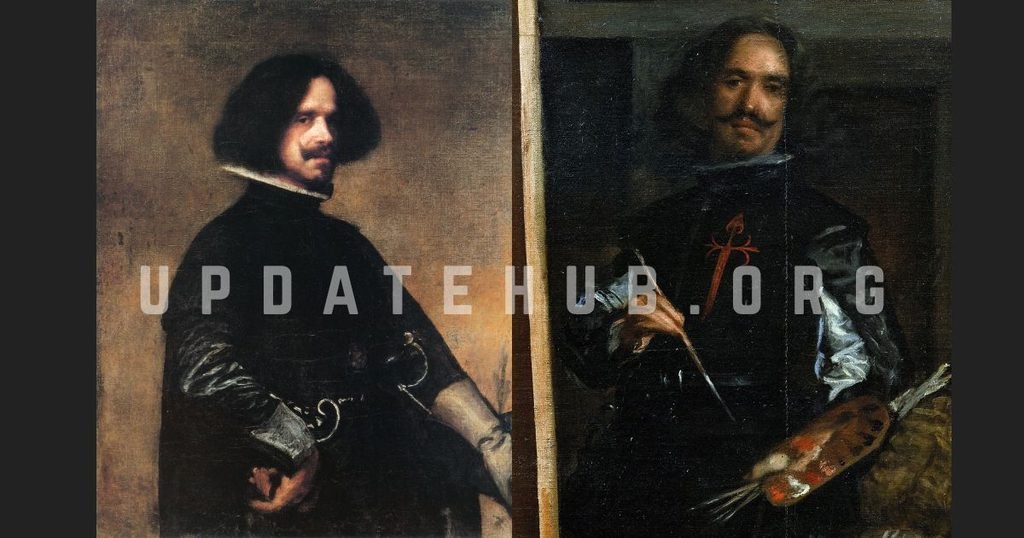
The importance of Las Meninas deserves special attention because it brings together many of the ideas that define Velázquez’s mature career.
At first, the painting appears to document an ordinary moment inside the royal palace.
A closer examination reveals something much more complex.
The mirror reflects the king and queen. The artist looks outward from the canvas. The young princess and her attendants face different directions. A doorway in the background introduces another layer of depth.
The viewer is left to reconstruct the scene.
This unusual structure makes the painting more than a royal portrait. It becomes a meditation on art itself.
Velázquez appears to ask what happens when reality is transformed into an image.
The painting also raises questions about the status of the artist. By placing himself prominently within a royal scene, he presents painting as an intellectual and respected profession.
That idea was significant during a period when artists could still be regarded primarily as craftsmen.
His Italian Journeys
Italy played an important role in Velázquez’s development.
He traveled there twice during his career. The first journey took place in the late 1620s, while the second began in 1649.
These visits allowed him to study major works of Italian Renaissance and Baroque art firsthand.
He encountered paintings associated with artists such as Titian, Tintoretto, and other influential masters.
The experience broadened his understanding of composition, color, human anatomy, and large-scale historical painting.
His second journey was particularly productive.
While in Rome, he painted Portrait of Pope Innocent X and Juan de Pareja, two works that demonstrate his mature approach to portraiture.
The Italian experience also helped him become more confident in handling color and paint.
After returning to Spain, his brushwork became increasingly free and suggestive.
Later Career and Final Years
Velázquez continued to enjoy a privileged position at the Spanish court during the final years of his life.
His professional responsibilities expanded, and he became involved in organizing palace ceremonies and other official matters.
In 1659, he was admitted to the Order of Santiago, an important honor that reflected his elevated social status.
This achievement was especially meaningful because artists did not always receive the same social recognition as members of traditional elite professions.
Velázquez died in Madrid on August 6, 1660.
His death marked the end of a remarkable career, but his artistic reputation continued to grow.
His wife, Juana, died only a few days after him.
Influence on Later Artists
The influence of Velázquez became particularly strong in the 19th and 20th centuries.
Édouard Manet admired his work and helped draw attention to his importance among modern European painters.
Manet’s interest was partly connected to the freedom of Velázquez’s brushwork. The Spanish painter showed that a convincing image could be created without describing every detail.
Pablo Picasso also engaged deeply with Las Meninas.
In the 1950s, Picasso created a large series of works based on Velázquez’s famous composition. Instead of simply copying the original, he broke it apart and reconstructed it through his own Cubist language.
Francis Bacon developed another famous response to Velázquez through his variations on Portrait of Pope Innocent X.
These examples show that his influence extended far beyond traditional academic painting.
Modern artists were interested not only in his technique but also in his ideas about perception, identity, space, and representation.
Why His Art Still Matters
The enduring appeal of Velázquez comes from the unusual combination of realism and ambiguity in his work.
He could paint an official royal portrait while allowing the sitter to appear like a real person.
He could create a historical scene without reducing its characters to simple heroes and villains.
Most importantly, he could make viewers aware of the act of looking.
His paintings reward close observation. A face, hand, piece of fabric, or background figure can become more interesting the longer the viewer studies it.
His work also demonstrates that artistic sophistication does not require excessive detail.
Sometimes a handful of carefully placed brushstrokes can communicate more than an entire surface covered with information.
That lesson remains relevant to painters and visual artists today.
Frequently Asked Questions
Who was Diego Velázquez?
Diego Velázquez was a Spanish painter of the Baroque period who lived from 1599 to 1660. He became the principal court painter to King Philip IV and created some of the most influential portraits and historical paintings of the Spanish Golden Age.
What is his most famous painting?
Las Meninas is generally considered his most famous painting. Created around 1656, it combines royal portraiture, complex perspective, mirrors, and questions about the relationship between artist and viewer.
What was his painting style?
His style evolved from the strong naturalism and dramatic lighting of his early Seville works toward a more fluid and atmospheric approach. His mature paintings often use loose brushwork, subtle color, natural light, and psychological observation.
Why is Las Meninas important?
The painting is important because it challenges conventional ideas about perspective and representation. Its mirror, figures, artist, and viewer create an unusually complex visual relationship.
Did he influence modern artists?
Yes. His work strongly influenced artists including Édouard Manet, Pablo Picasso, and Francis Bacon. They admired his handling of paint, portraiture, composition, and ideas about visual perception.
Conclusion
Diego Velázquez transformed Spanish Baroque painting through his extraordinary understanding of people, light, space, and visual perception.
His journey from a young painter in Seville to a celebrated artist at the court of Philip IV demonstrates an exceptional artistic evolution. His early naturalism provided the foundation for a mature style that became increasingly subtle, confident, and innovative.
Works such as Las Meninas, The Surrender of Breda, Portrait of Pope Innocent X, Juan de Pareja, and The Rokeby Venus reveal different sides of his achievement.
Yet his importance extends beyond individual masterpieces.
Velázquez changed the possibilities of portraiture and showed that a painting could be realistic without being rigidly detailed. He also demonstrated that a visual composition could raise complex questions about identity, observation, and reality.
Centuries after his death, artists continue to study his paintings and reinterpret his ideas. His influence on modern art confirms the remarkable durability of his vision.
His work remains powerful because it does more than show us what people looked like. It invites us to think about how we see, what we notice, and how art transforms reality into something lasting.Show less
